

A metaphor for the future
The oldest baobab tree is estimated around 2000 years old. That is around the time we started counting our years. Just imagine. And when you plant a baobab seed toady, it will only grow its first fruits after 25 or 200 years. That is why the baobab tree is a beautiful symbol for good ancestry and regenerative thinking. A metaphor for the future thinking. Who will reap the fruits of the seeds that we plant today? What will life be like then?
The future inspires me. I like the wonder, the possibilities and the creation. But in school, we are only taught history. Why is that? I want to invite everyone to paint pictures of the world we want ourselves and our children to live in tomorrow. Let’s imagine future scenarios and learn to have a constructive dialogue on needs and solutions.
Below I highlight the biggest issues in Gambia today. All of them go beyond generations and boarders. And I think this baobab project can impact them all.
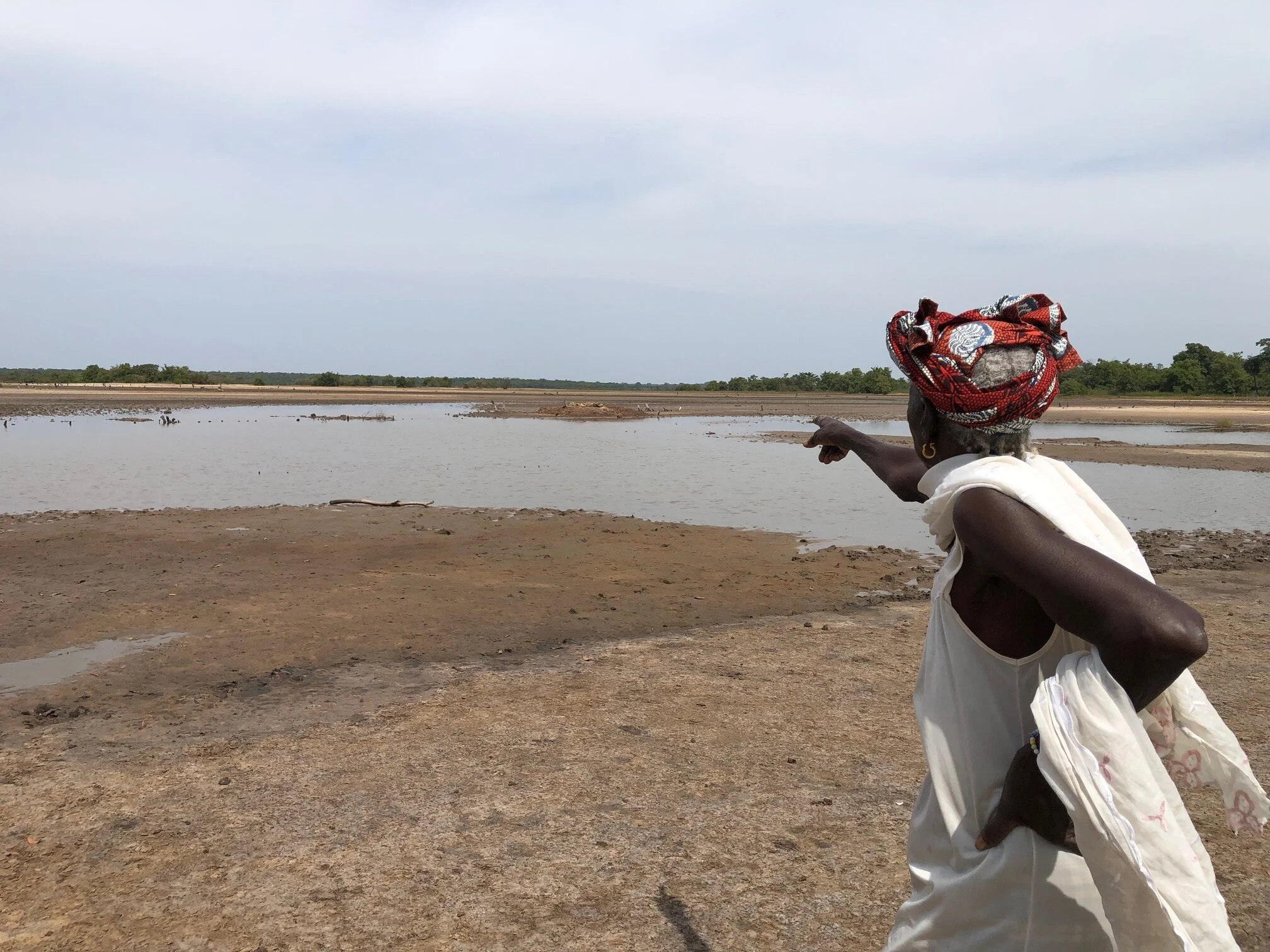
A woman on the south bank of the Gambia river, pointing at land that was once green. Land is drying as a result of climate change, including increasing sea levels and salted river water.
Climate change
Gambia’s contribution to global greenhouse gas emissions is negligible, at around 0.01%. But climate change caused by more developed countries has devastating effects on Gambia. For instance, the current annual mean temperature of approximately 28°C is projected to increase by 3 - 4.5°C by 2100. From 1950 to 2000 annual rainfall amounts have decreased by about 30%, and average rainfall is projected to be less than 500 mm per year by 2100. To compare: 1982-1983 was an extreme drought year with 480 mm per year.
Gambian farming is being seriously affected as a result of droughts, floods, rising sea levels, and reduced available arable land. Already, reduced rains have caused a reduction in land available for agriculture and a 21 - 44% decrease in food crop production.
(Source: National Climate Change Policy of The Gambia)
Deforestation and desertification
Baobab trees are experts in containing water in their trunks in the driest of lands. Sadly, many trees in Gambia, including baobab trees, are chopped for urban settlements and agricultural development. Deforestation, together with climate change, reduces ground water levels and rainfall.
Well-known negative effects of deforestation are loss of biodiversity and the release of large amounts of carbon into the atmosphere. What is lesser known is its impact on the worsening droughts. Trees do not only contribute to rain, but they can influence the amount and timing of downpours.

A baobab tree is an expert in surviving in extremely dry climate conditions.
Trees retain moisture in the soil with their root systems and collect it on their leaves, branches and trunk. This moisture evaporates to form clouds. The shade of a tree prevents moisture from rapidly evaporating. A treeless savannah is hotter and releases water from rains all at once. Without trees the soil stores far less water, with up to 30% reduction in evaporation and a corresponding reduction in rainfall. The reduced water storage and rains results in longer dry seasons, and drought. The rainy season still occurs, but in Gambia it has already reduced from 6 to 3 months in the last years.
This leads to a vicious circle. When trees are chopped, the rain decreases at a faster rate, leading to longer droughts and higher temperatures. Trees die when this happens over a longer time. And it is happening, even baobabs are dying. Chopped and dead trees increase the contribution of CO2 into the atmosphere, speeding up climate change and the deforestation-drought loop.
(Source: JSTOR Science & Technology)
Poverty and subsistence farming
Gambia ranks 174 out of 189 countries in the 2019 Human Development Index. Despite considerable progress in recent years – particularly in primary education – about half of the Gambian population is poor. About 10% suffers from food insecurity and acute malnutrition, and 23% of children are stunted or small for their age. Main causes include weak food production systems and drought.
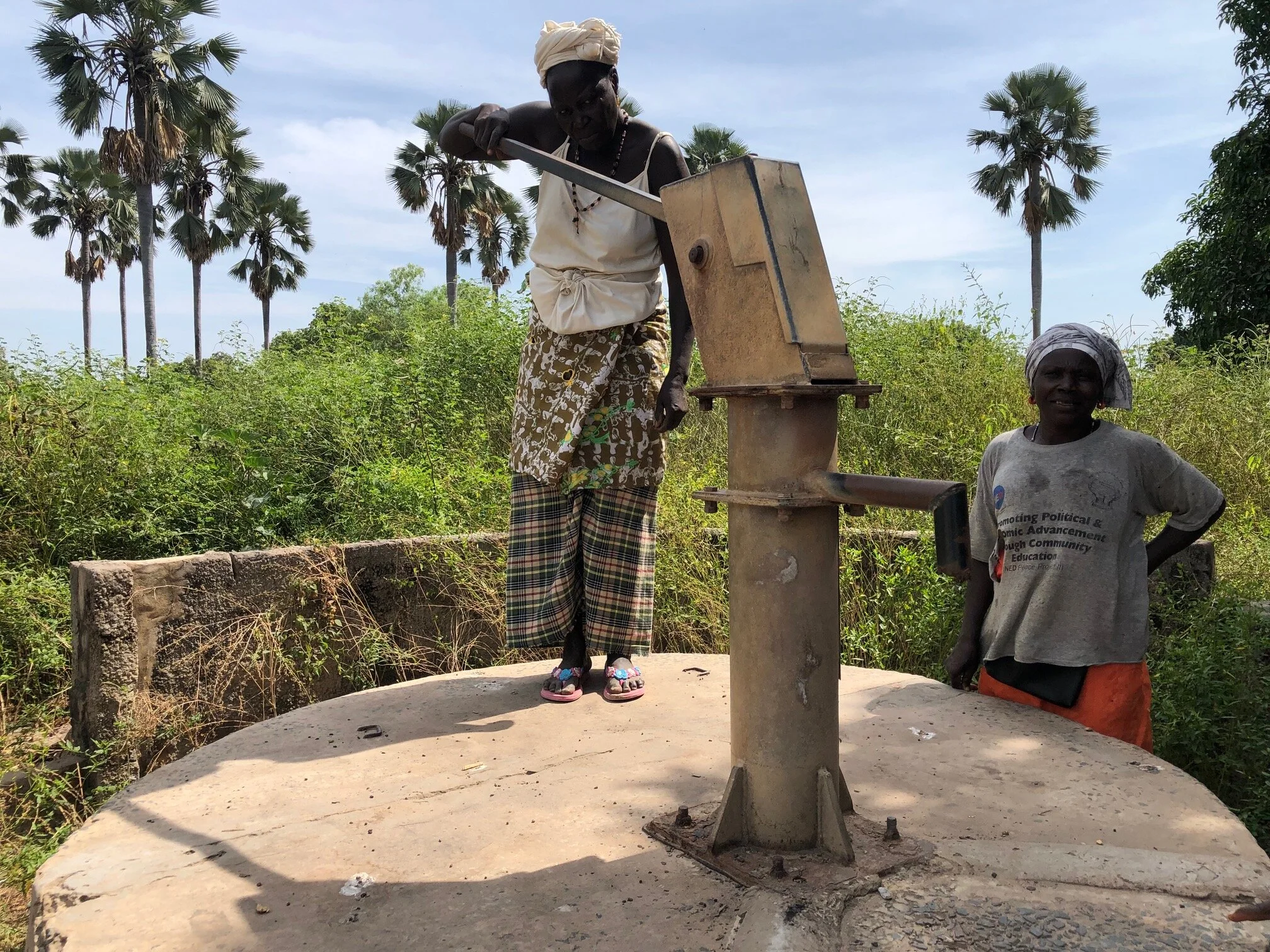
A water pump that was used for subsistence farming, but that is not working anymore. Boreholes need to be drilled increasingly deep, as groundwater levels are decreasing,
Agriculture employs 46% of the population and up to 80% in rural areas. Most of them depend on subsistence farming. Desertification and lack of access to (electricity for) water impacts the number of suitable crops and decreases harvest times, leading to hunger. For instance, crop production fell by 26% in 2017, because of long droughts. Clearing of land for more agricultural activities during the shortening harvest season, and poor practices due to lack of education and investments, leads to increasing deforestation and desertification. This is another vicious cycle, keeping poverty levels up.
Also important to note: Agricultural growth in Gambia has only been half of the national target. Gambia produces only 50% of the food it needs, and it depends on food imports. Fluctuating market prices especially effect vulnerable households, who spend half their income on food. Low investments in national food production and processing also reduce income- and job opportunities. The sector is stuck in yet again a vicious circle of low investment and low output.
(Source: World Food Program)
Employment and migration
With a population of around 2 million, youths (aged 13-30) constitute 37% of all Gambians. Unemployment is very high and has been increasing to 38% of youths. To make the calculation for you: almost 300,000 youths are jobless. Most Gambian that do have work are engaged in low productivity jobs with low wages and have no formal education.
Only 11% of the labour force has technical and vocational education and training. But even with training, Gambia does not generate adequate employment opportunities for young job seekers that often migrate from rural to urban areas. The country imports almost all of its products, and - beside low investments in food production and processing - the national services and low manufacturing sectors are poorly developed or non-existing.
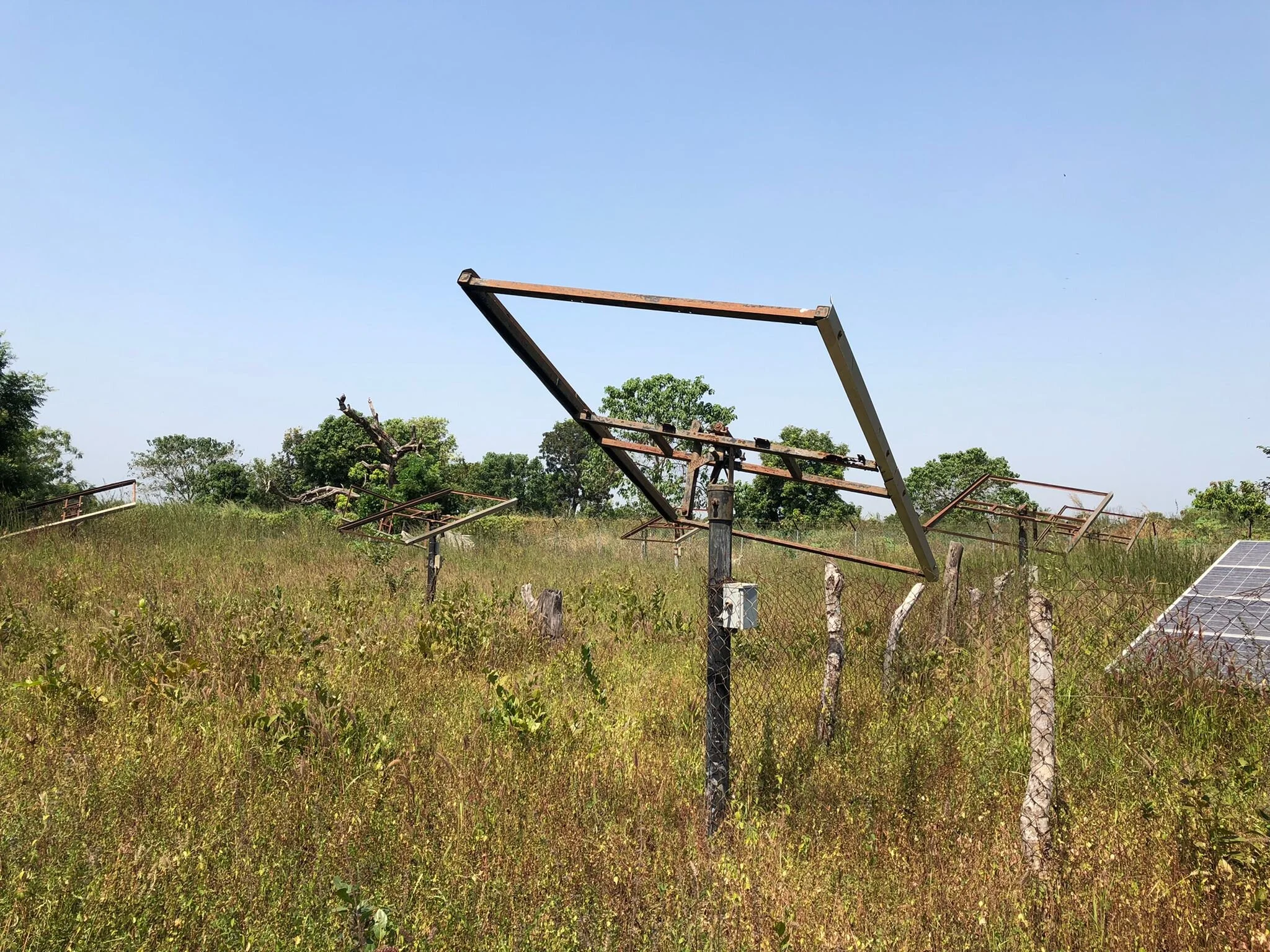
A common example of poor donor- or government projects. This is a solar system for water access and irrigation in two villages. Skills and maintenance were lacking, and the connected water tank is leaking and largely useless.
To escape climate change and poverty, many youths - especially boys and increasingly also girls - choose ‘the back-way’, or illegal migration. Many youths experience their situation in Gambia as a waste of talent. Without agricultural, educational or job opportunities, they hope that EU and US will provide opportunities to build a better future.
Between 2014 and 2017, around 1.7 million people risked their lives by crossing the Mediterranean Sea for Europe in small boats. Over 13,000 have died or gone missing. Although it is mainly men migrating, the scale of migration is also having an impact on women. Women farmers become a growing proportion of the agricultural workforce, and women and families left behind by migrating husbands can become dependent and are at greater risk of poverty.
I do believe Gambians should be making better plans to structurally invest in their own and their country’s future. Escaping through the backdoor is not the solution. Still, I understand that migration is considered a successful strategy for personal, family and national development by Gambians. If we do not invest in personal plans to build a better future in Gambia, they come and get the investments themselves. Money and knowledge send back by those that have successfully migrated are contributing to the development of their families and country. Remittances alone averaged EUR 160 million a year during 2013 and 2015. That is equivalent to around 20% of GDP, one of the highest proportions in the world.
(Source: Action Aid)
As I see it, migration is the topic that takes climate change and poverty to our own doorstep. In recent years migrants are one of the main causes of tension and polarisation in EU countries. But do we know each other’s stories? What are their histories, dreams, fears, and what are yours? What is their responsibility, and what is yours? Looking at the future, how do we come to a new picture that creates shared value and innovates the system?
We need to invest in solutions beyond our own generation and boarders for everybody to benefit.